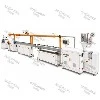
Extruders originated in the 18th century. The first extruder, a manual piston extruder built by Joseph Bramah (England) in 1795 for manufacturing seamless lead pipes, is considered the world's first. From then until the first 50 years of the 19th century, extruders were primarily used for lead pipe production, pasta and other food processing, and the brick and ceramics industries. The first documented development of extruders as a manufacturing method was R. Brooman's 1845 patent application for the production of Goodyear rubber wire using an extruder.
This extruder was subsequently improved, and in 1851 it was used to cover the copper wire of the first submarine cable between Dover and Calais companies. In 1879, the Englishman M. Gray obtained the first patent for an Archimedes spiral screw extruder. Over the next 25 years, extrusion methods gradually gained importance, and electrically operated extruders rapidly replaced the previously manual ones. In 1935, the German machinery manufacturer Paul Troestar produced an extruder for thermoplastics. In 1939, they developed plastic extruders to their current stage-the modern single-screw extruder stage.