

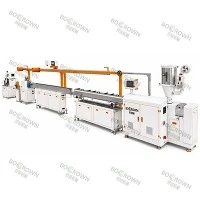


Central Dust Removal
Product Overview
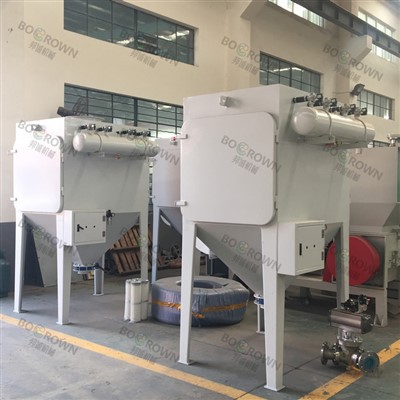
The Industrial Central Dust Removal System is engineered for continuous particulate extraction across multi-station manufacturing facilities. By consolidating localized pollution sources into a single, high-efficiency negative pressure network, the system captures airborne dust, chips, and hazardous fumes at the point of origin.
Unlike standalone units, this central architecture integrates heavy-duty centrifugal blowers, automated reverse-pulse filter cleaning, and modular hopper discharge options. It maintains stable static pressure across long duct runs, ensuring compliance with OSHA and ATEX air quality mandates while reducing localized noise and floor clutter.

Key Features & Benefits
Modular Multi-Station Integration:
Scalable manifold inlets allow simultaneous extraction across 5 to 50+ drop points without pressure drops at distant workstations.
Explosion-Vented Containment:
Built-in rupture panels and suppression systems comply with NFPA 652/654 standards for combustible dust handling (aluminum, wood, or polymer fines).
Direct-Drive Impeller Dynamics:
Dynamically balanced backward-inclined centrifugal fans deliver static efficiencies exceeding 82%, lowering baseline kilowatt-hour draw per CFM.
Enclosed Rotary Airlock Discharge:
Continuous material evacuation from the hopper without breaking system negative pressure, preventing dust leakage during operation.
Technical Specifications
|
Technical Parameter |
Standard Specification Range |
Custom Engineering Options |
|
Airflow Capacity (CFM / m3/h) |
3,000 to 45,000 CFM (5,000 to 76,000 m3/h) |
Up to 100,000+ CFM (Multi-fan modular arrays) |
|
Static Pressure Range |
2,500 Pa to 4,500 Pa (10 to 18 in.wg) |
High-pressure configurations up to 6,000 Pa |
|
Filtration Efficiency |
99.9% down to 0.5 micron (Standard spunbond polyester) |
99.97% at 0.3 micron (PTFE membrane / HEPA final stage) |
|
Filter Media Options |
Spunbond Polyester, Antistatic Aluminized, Flame Retardant |
Nano-fiber coating, Oleophobic/Hydrophobic treatment |
|
Filter Cleaning Type |
Compressed Air Pulse-Jet (0.5 - 0.7 MPa working pressure; Consumption: 0.12 Nm3/min per valve) |
Online sequential cleaning with diaphragm valve isolation |
|
Housing Construction |
3mm to 5mm carbon steel plate (A36 / Q235B) |
304 / 316L Stainless Steel for corrosive environments |
|
Electrical Supply |
380V-480V, 3-Phase, 50Hz/60Hz (IP55 / NEMA 4 enclosure) |
IECEx / ATEX Zone 22 certified electrical components |

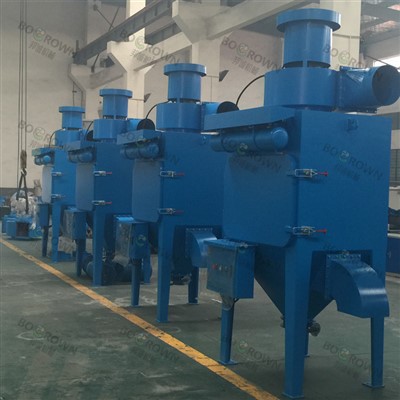
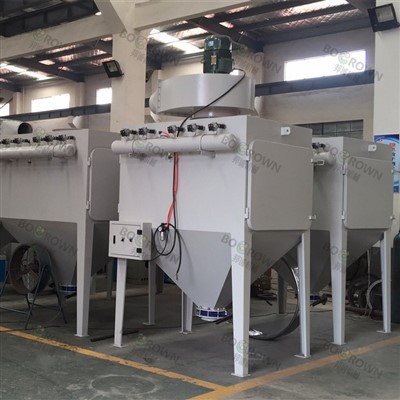
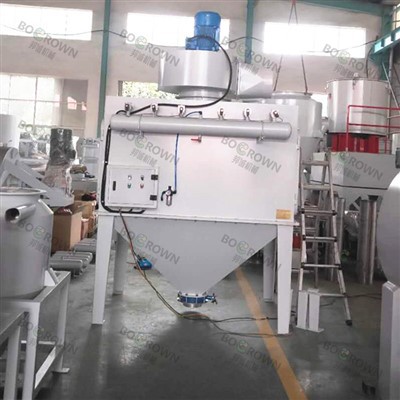
Centrifugal Blower Fan: Powered by TEFC (Totally Enclosed Fan-Cooled) IE3/IE4 high-efficiency motors, vibration-isolated to dampen structural resonance.
Vertical Cartridge Filter Array: Arranged horizontally or vertically for rapid tool-free cartridge extraction via quick-release cam-lock mechanisms.
Pulse-Jet Manifold & Solenoid Valves: Fast-acting diaphragm valves paired with an internal compressed air receiver tank for shock-wave dust dislodgement.
V-Cone / Pyramidal Hopper: Engineered hopper angles (>60 degrees) coupled with pneumatic vibrators to eliminate bridging of fine or sticky particulate matter.
PLC Control Cabinet: HMI touch-screen interface housing Siemens/Schneider switchgear, differential pressure gauges (Magnehelic/digital transducers), and VFD speed control.
Applications
Laser & Plasma Cutting:
Laser & Plasma Cutting: Captures heavy metallic fume, fine oxide dust, and slag particles generated by high-power CNC thermal cutting tables. Integrates via flanged duct collars directly matched to machine exhaust outlets (typically 200mm to 400mm diameter connections).
Woodworking & Panel Processing:
Extracts high-volume sawdust, MDF chips, and combustible wood fibers from CNC routers, edge banders, and sanding lines.
Metal Machining & Grinding:
Removes abrasive swarf, cast iron dust, and alloy particles from milling, turning, and surface grinding operations.
Bulk Powder & Chemical Handling:
Controls toxic or nuisance dust during pneumatic conveying, weighing, mixing, and bagging processes.
Manufacturing Capabilities & Quality Assurance
Sheet Metal Fabrication: Cutting executed via Trumpf/Bystronic fiber laser cutting machines (tolerance +/-0.1 mm), paired with CNC press brakes for precise structural bending.
Welding Standards: Structural seams completed by certified welders adhering to AWS D1.1 / ISO 3834 standards, ensuring air-tight duct and housing integrity under negative pressure.
Surface Preparation & Coating: Steel components undergo grit blasting (Sa 2.5 standard), followed by automated electrostatic epoxy powder coating or acid-resistant polyurethane painting (min. DFT 120 um).
Factory Acceptance Testing (FAT): Every blower assembly undergoes dynamic rotor balancing (ISO 1940 Grade G6.3), current-draw verification, and pressure leakage testing prior to crating.
Compliance Certifications: CE Machinery Directive 2006/42/EC, ISO 9001 Quality Management System, and optional ATEX / UL-listed control panels.
Acoustic Enclosures: Sound-attenuating housing panels reducing blower noise levels below 75 dB(A) at 1 meter.
Explosion Protection Packages: Integrated explosion vents, chemical isolation valves (flap valves), and spark detection/extinguishing systems for wood or metal dust lines.
High-Temperature Ducting & Media: Nomex or fiberglass filter media rated for continuous operating temperatures up to 200 degrees C.
Intelligent VFD Integration: Automatic blower speed modulation based on real-time damper positions across individual workstations, cutting electricity consumption by up to 40%.

Delivery & After-Sales Support
Modular Packaging: Units disassembled into standardized shipping modules (standard container or flat-rack compatible) to minimize ocean freight costs and ease site rigging.
Documentation Package: Comprehensive technical binder supplied upon shipment, including P&ID schematics, electrical wiring diagrams, third-party material test reports (MTRs), and CE declarations.
Spare Parts Availability: Stocked critical replacement items (diaphragm valve repair kits, differential pressure sensors, replacement filter cartridges) dispatched within 48 hours.
Engineering Support: Remote commissioning assistance via video telemetry or on-site engineering supervision for complex multi-zone duct network tie-ins.
Frequently Asked Questions

Request a Quote
To configure a central dust removal system matched to your facility's operational parameters, please provide the following details to our engineering team:
Number and type of extraction points (e.g., laser cutters, woodworking routers).
Estimated total required airflow (CFM or m3/h) and maximum duct run length.
Material characteristics (particle size, combustibility, moisture content).
Target electrical supply and regional compliance standards (CE, UL, ATEX).