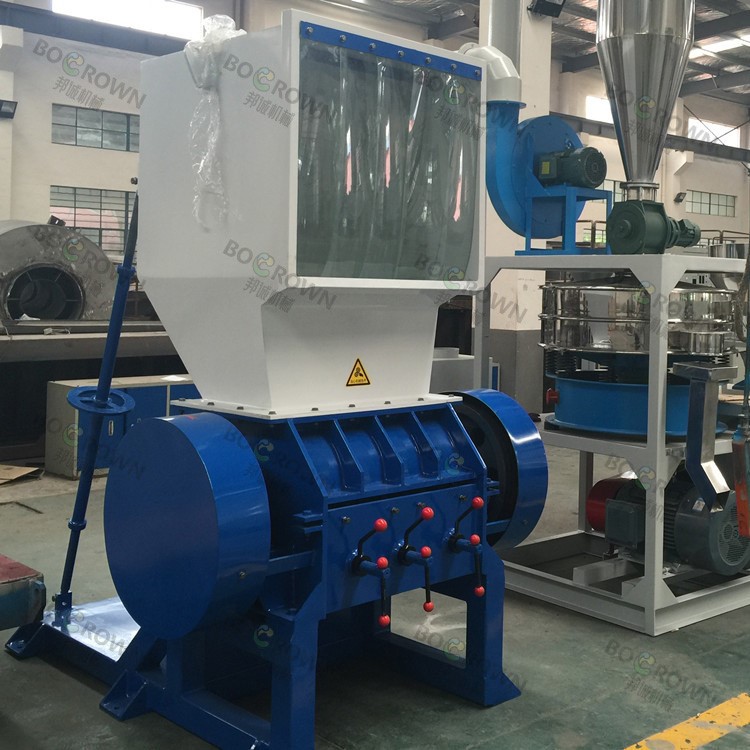
Jaw Crusher: A jaw crusher is a crushing machine that uses the squeezing and bending action of two jaw plates to coarsely or medium crush materials of various hardnesses. Its crushing mechanism consists of a fixed jaw plate and a movable jaw plate. When the two jaw plates approach each other, the material is crushed; when the jaw plates separate, material smaller than the discharge opening is discharged from the bottom. Its crushing action is intermittent. This type of crusher is widely used in mineral processing, building materials, silicate, and ceramic industries due to its simple structure, reliable operation, and ability to crush hard materials.
Gyratory Crusher: Gyratory crushers use two methods to adjust the discharge opening and implement overload protection: The first is a mechanical method, where an adjusting nut on the upper end of the main shaft raises or lowers the crushing cone, thus increasing or decreasing the discharge opening. In case of overload, a safety pin on the transmission pulley is cut off. The second method is a hydraulic gyratory crusher, where the main shaft sits on a plunger within a hydraulic cylinder. Changing the volume of hydraulic oil under the plunger alters the vertical position of the crushing cone, thereby changing the size of the discharge opening. In case of overload, the downward pressure on the main shaft increases, forcing the hydraulic oil under the plunger into the accumulator in the hydraulic transmission system, causing the crushing cone to descend and increase the discharge opening, expelling non-crushable materials (ironware, wood blocks, etc.) that entered the crushing chamber with the material, thus achieving safety.
Cone Crusher: The working principle of a cone crusher is the same as that of a gyratory crusher, but it is only suitable for medium or fine crushing operations. The uniformity of discharge particle size is generally higher in medium and fine crushing operations than in coarse crushing operations. Therefore, a parallel zone must be set in the lower part of the crushing chamber. At the same time, the rotation speed of the crushing cone must be accelerated so that the material is subjected to more than one compression in the parallel zone.