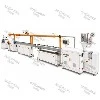
A single screw extruder is generally divided into three sections in its effective length, determined by the screw diameter, pitch, and depth, typically each section occupying one-third of the total length.
The section beginning with the last thread at the feed inlet is called the conveying section. Here, the material should not be plasticized, but rather preheated and compacted under pressure. Traditional extrusion theory considered this section to be a loose mass, but later studies have shown that the material's movement here resembles that of a solid piston; therefore, its function is simply to convey the material.
The second section is called the compression section. Here, the screw channel volume gradually decreases, and the temperature reaches the point where the material is plasticized. Compression occurs here, starting from the third section and decreasing to the first section. This is called the screw compression ratio-3:1 (some machines may have variations). The plasticized material then enters the third section.
The third section is the metering section. Here, the material is kept at the plasticizing temperature, but the molten material is accurately and quantitatively delivered to the die head, similar to a metering pump. The temperature here must not be lower than the plasticizing temperature, and is generally slightly higher.