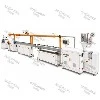
The transmission system typically consists of an electric motor, a gearbox, and bearings. During extrusion, the screw speed must remain stable and not change with the screw load to maintain consistent product quality. However, in different applications, screw speed regulation is required to allow a single machine to extrude different plastics or products. Therefore, this part generally uses AC commutator motors or DC motors to achieve stepless speed regulation, with screw speeds typically ranging from 10 to 100 rpm.
The transmission system drives the screw, supplying it with the torque and speed required during extrusion. It usually consists of an electric motor, a gearbox, and bearings. Under the premise of a basically the same structure, the manufacturing cost of a speed reducer is roughly proportional to its size and weight. A larger size and weight of the speed reducer means more material is consumed during manufacturing, and larger bearings are also required, increasing manufacturing costs.
For extruders with the same screw diameter, high-speed, high-efficiency extruders consume more energy than conventional extruders. Doubling the motor power necessitates a correspondingly larger speed reducer frame size. However, higher screw speeds mean lower reduction ratios. For reducers of the same size, those with lower reduction ratios have a larger gear module compared to those with higher reduction ratios, thus increasing the reducer's load-bearing capacity. Therefore, the increase in the size and weight of the reducer is not linearly proportional to the increase in motor power. If we use the extrusion volume as the denominator and divide by the reducer weight, the result is smaller for high-speed, high-efficiency extruders and larger for conventional extruders. In terms of unit output, the lower motor power and lighter reducer of high-speed, high-efficiency extruders mean that their unit output machine manufacturing cost is lower than that of conventional extruders.