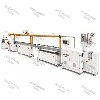
As core equipment in the fields of solid waste treatment and resource recovery, industrial shredders rely primarily on powerful mechanical forces to break down materials. Their operating principles can be summarized in the following four key stages:
The core operating principle of industrial shredders differs from the impact-based mechanism of traditional crushers. Instead, a motor drives a reduction unit that rotates one or more cutter shafts at very low speeds (typically tens of revolutions per minute) while generating immense torque. This design enables the high-strength alloy steel blades mounted on the shafts to exert tremendous shearing force, acting like giant scissors to forcibly tear, cut, and sever materials entering the shredding chamber.
Simultaneous with the shearing process, precise meshing clearances are formed between the rotating blades and the stationary blades (fixed to the housing), as well as between the blades of adjacent shafts. Once the material is gripped by the blade tips, it undergoes intense compression and tearing within these narrow gaps. This multi-directional mechanical force allows the machine to easily handle complex materials-such as those that are highly prone to tangling, exceptionally tough, or very hard-ensuring thorough shredding into uniform, small particles without jamming or wrapping around the cutter shafts.
To handle non-shreddable foreign objects that may be mixed into industrial waste, modern industrial shredders are typically equipped with advanced intelligent control systems. When the system detects a sudden, abnormal spike in main shaft load or a jam caused by a hard object, the PLC control system instantly issues a command to stop the cutter shafts and reverse their rotation. This automatic reversal mechanism quickly ejects the foreign object, effectively protecting the blades and drive system from damage; the machine then automatically resumes normal operation, significantly enhancing its continuous processing capability.
Shredded material must pass through a screening system to determine the final output size. A screen with specific aperture dimensions is usually installed at the bottom of the shredding chamber; material is discharged under gravity only after it has been shredded into pieces smaller than the screen apertures. Oversized material is retained within the crushing chamber, undergoing repeated shearing and tearing by the cutter shafts until it meets the required specifications, thereby ensuring uniform and controllable output particle size.
If you are in need of industrial shredders, ZJG BC Machinery is your ideal choice. Our technical team can customize equipment configurations to meet specific customer requirements.