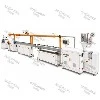
Working Principle of the Extrusion Machine
The extrusion machine is a highly efficient continuous molding device. Its core operating principle involves using mechanical action to force solid raw materials into continuous products of a specific shape under precisely controlled temperature and pressure conditions. The entire process comprises four key stages:
1. Raw Material Conveying and Compression
Before production begins, pre-treated plastic pellets or powder enter the extruder's metal barrel via a hopper. Inside the barrel, a high-speed rotating screw acts as a powerful propeller; its helical flights continuously convey the loose solid material forward. As the depth of the screw channel gradually decreases, the material is continuously compacted during its forward movement, and trapped air is effectively expelled, creating a dense, prepared mass for the subsequent melting and plasticization stages.
2. Heating, Melting, and Plasticization
This is the most critical stage of the extrusion process. The material inside the barrel is subjected to two heat sources simultaneously: stable external heat provided by heating bands on the barrel's exterior, and internal shear heat generated by intense friction between the material, the screw, and the barrel wall. Through the synergistic effect of this dual heat, the solid material gradually softens and transforms into a uniform, continuous molten state, ensuring high consistency in the material's physical properties.
3. Pressurized Extrusion and Molding
Driven by the continuous thrust of the screw, the uniformly plasticized melt is pushed toward the die head at a controlled rate and pressure. A specialized flow channel design within the die head converts the material's initial helical motion (following the screw's rotation) into a smooth, linear flow. Subsequently, the high-temperature melt is forced through a precision-engineered die of a specific shape; as it passes through, the melt acquires its final cross-sectional profile-such as that of a pipe, sheet, or profile section.
4. Cooling, Sizing, and Haul-off
If the high-temperature product extruded from the die were exposed directly to the air, it would deform under its own weight. Therefore, the extrudate must immediately enter a cooling and sizing unit to rapidly cool and solidify, thereby precisely locking in the product's dimensions and shape. At the same time, the haul-off unit continuously draws out the cooled product at a uniform and stable speed, followed by cutting or winding as required, thereby completing the entire continuous production process.
If you would like to learn more about extrusion machines and related details, please contact ZJG BC Machinery; our team is happy to assist you.